
A decade of data tells a different story about where the steadier, more affordable opportunities really sit
Ask most first-time investors where the “safe” property money goes, and they’ll point straight at Sydney or Melbourne. Capital cities get the headlines, the auction clearance rates, and the dinner-party bragging rights. Regional Australia gets treated as the fallback option — somewhere you settle for when the capitals are out of budget.
The data tells a different story. Looking back across the past ten years of the Australian property market, regional Australia hasn’t just kept pace with the capital cities — in several important respects, it’s been the steadier, more resilient, and more accessible place to build a portfolio.
A decade of growth, side by side
Here’s how combined capital city and combined regional capital growth have tracked since 2016:
| Year | Combined Capitals | Combined Regionals |
|---|---|---|
| 2016 | 5.00% | 4.00% |
| 2017 | 11.00% | 5.80% |
| 2018 | -1.00% | 4.00% |
| 2019 | -7.50% | -1.00% |
| 2020 | 10.00% | 4.50% |
| 2021 | 4.00% | 12.00% |
| 2022 | 23.50% | 29.00% |
| 2023 | -8.00% | -4.00% |
| 2024 | 10.50% | 6.80% |
| 2025 | 3.50% | 6.00% |
| 10-year average | 5.10% p.a. | 6.71% p.a. |
Over the full decade, regional Australia has actually delivered the stronger average annual capital growth — and it’s achieved that with noticeably smaller drawdowns when the broader market turned.
When markets wobble, regional has the shock absorbers
Look closely at the three years the combined capitals went backwards, and the pattern is consistent:
In 2018, as lending standards tightened in the wake of the Royal Commission, the capitals slipped -1.0% while regional markets still posted +4.0% growth. In 2019, during the deeper credit squeeze that followed, the capitals fell -7.5% — regional Australia eased back just -1.0%. And in 2023, as the fastest rate-hiking cycle in a generation worked its way through borrowing capacity, the capitals dropped -8.0% while regional markets fell a comparatively shallow -4.0%.
In every downturn over the past decade, regional Australia’s correction has been less than half as severe as the capitals’. That’s not a coincidence. Capital city markets — particularly Sydney and Melbourne — carry a larger share of investor and credit-sensitive buyers, which means tighter lending conditions and rate hikes hit harder and faster. Regional markets are more heavily weighted toward owner-occupiers, lifestyle and tree-change buyers, and local employment-driven demand, which tends to cushion the downside when financial conditions tighten.
A lower entry price, a bigger margin for error
Resilience isn’t the only advantage. Affordability matters just as much, especially in a higher-for-longer interest rate environment.
As at February 2026, Cotality’s Home Value Index put the median dwelling value across the combined capitals at $1,014,401, against $751,327 across combined regional markets — a gap of roughly $263,000, or close to 26% cheaper to get in. That’s a smaller deposit, a smaller loan, and meaningfully more breathing room if rates move or personal circumstances change. It’s also worth noting regional values actually grew faster over the most recent year (11.1%) than the combined capitals (9.6%), so the affordability gap isn’t coming at the cost of growth.
The yield advantage that supports cash flow
Capital growth is only half of the investment equation — cash flow is what gets an investor through a holding period without stress, particularly with borrowing costs where they are.
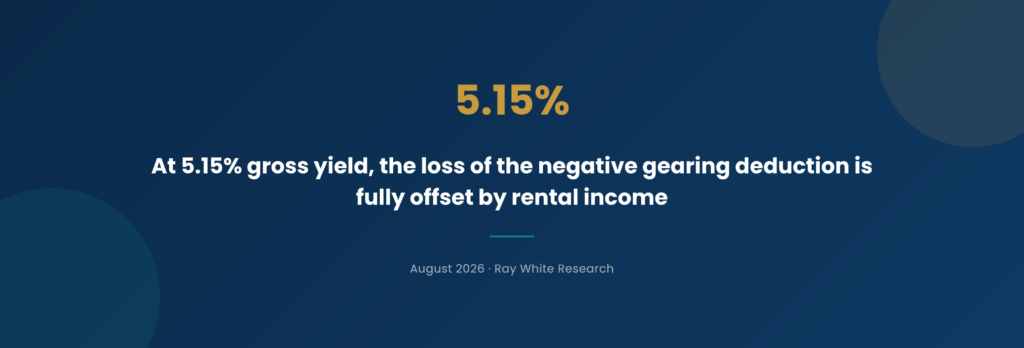
This is where regional markets pull further ahead. Sydney’s median house price of around $1.52 million currently delivers a gross rental yield of roughly 3%. Regional NSW, with a median closer to $802,000, is delivering yields around 4.2% — and considerably higher in many individual centres. The pattern holds nationally: some of the country’s highest rental yields for both houses and units are consistently found in regional Western Australia, the Northern Territory and other regional centres, rather than in the capital CBDs. For an investor weighing up serviceability, that yield gap can be the difference between a property that supports itself and one that quietly drains the household budget every month.
It’s not a niche market — it’s a third of the country
One of the most persistent myths about regional Australia is that it’s a thin, low-demand market. The population numbers say otherwise.
As at June 2026, Australia’s population stood at 28 million. The eight capital cities combined — Sydney, Melbourne, Brisbane, Perth, Adelaide, Hobart, Darwin and Canberra — accounted for about 18 million of that. That leaves close to 10 million Australians, or roughly one in three, living outside the capitals.
And these aren’t all small country towns. The Gold Coast–Tweed Heads region alone is home to more people than Hobart and Darwin combined. Newcastle–Maitland has a larger population than Canberra. Closer to home for Victorian investors, Geelong, Ballarat and Bendigo are each significant cities in their own right, with fast-growing satellite centres like Warragul–Drouin among the strongest-growing urban areas in the entire country over the past five years. Regional demand isn’t a rounding error — it’s a structurally large and growing share of the national property market.
The caveat that matters
None of this means every regional town is a buy. Resource-dependent towns can boom and bust hard when commodity cycles turn, and not every regional centre has the economic diversification, infrastructure pipeline or population growth fundamentals to back up its current pricing. The same discipline that should be applied to picking a suburb in Melbourne or Brisbane needs to be applied to picking a regional location — arguably more so, given the smaller, more concentrated local economies involved.
That’s precisely where the data above becomes useful rather than just reassuring. It tells investors where to start looking — toward diversified regional economies with genuine population and infrastructure tailwinds — rather than treating “regional” as a single, undifferentiated category.
The bottom line
A decade of market data doesn’t support the idea that regional Australia is the consolation prize for buyers who can’t afford the capitals. It points to a market that has grown faster on average, fallen less in every downturn, costs roughly a quarter less to enter, and rents at a noticeably stronger yield — all while housing close to nine million Australians and growing.
For investors building a resilient, long-term portfolio, regional Australia deserves a seat at the table, not a footnote. At Nest or Invest, we help investors across Victoria, Queensland, Western Australia and South Australia assess opportunities in both metro and regional markets with the same data-driven, independent approach — because the right location is the one backed by fundamentals, not just postcode prestige.
Disclaimer: This information is for educational purposes only and does not constitute financial advice. Past performance is not a reliable indicator of future results. Always do your own research or consult a licensed professional before making investment decisions.
Sources: CoreLogic/Cotality Home Value Index; Australian Bureau of Statistics, National, State and Territory Population (June 2025) and Regional Population (2024–25); API Magazine; OpenAgent; loans.com.au.