


The 10-Year Rule: What CoreLogic’s Pain & Gain Data Reveals About Houses vs Units
There’s a piece of property folklore that gets repeated at every barbecue: “just hold for long enough and you can’t lose.” It turns out that’s only half true — and which half depends almost entirely on whether you’re holding a house or a unit.
CoreLogic (now operating as Cotality) has tracked this exact question for years through its quarterly Pain & Gain research, which compares every property resale against its previous purchase price and records not just whether the sale was a profit or a loss, but the median number of years the owner actually held the property in each case. Run that lens over houses and units separately, and a genuinely useful pattern emerges.
What the Numbers Actually Measure
The table below isn’t showing percentages — it’s showing median hold period in years. The “Pain” columns are how long, on average, owners held a property before selling it at a loss. The “Gain” columns are how long owners held a property before selling it at a profit. Read side by side, the gap between those two numbers tells you how much patience actually matters in each market and dwelling type.
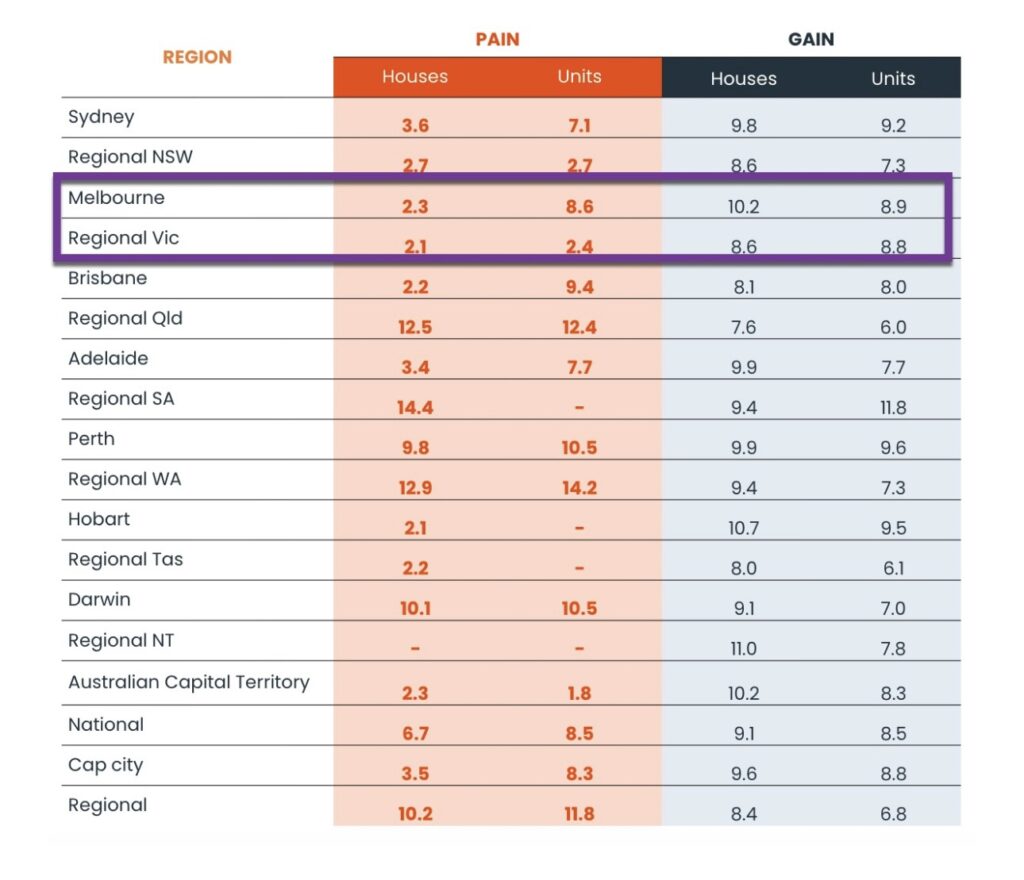
Median hold period (years) for loss-making (Pain) vs profit-making (Gain) resales, by region and dwelling type. Source: CoreLogic Pain & Gain research.
Houses: The Longer You Hold, the Stronger the Profit
For houses, the pattern across most of Australia’s established markets is strikingly consistent: properties sold at a loss had been held for only a few years, while properties sold at a profit had typically been held for the better part of a decade.
| Market | House — Pain (years) | House — Gain (years) |
|---|---|---|
| Melbourne | 2.3 | 10.2 |
| Hobart | 2.1 | 10.7 |
| Australian Capital Territory | 2.3 | 10.2 |
| Sydney | 3.6 | 9.8 |
| Adelaide | 3.4 | 9.9 |
| Regional Vic | 2.1 | 8.6 |
| Regional NSW | 2.7 | 8.6 |
| Brisbane | 2.2 | 8.1 |
| National | 6.7 | 9.1 |
Melbourne is the standout example: houses that sold at a loss had been held for a median of just 2.3 years, while houses that sold at a profit had been held for 10.2 years — more than four times as long. The same basic shape repeats in Hobart, Canberra, Sydney, Adelaide, and across regional NSW and Victoria. The takeaway isn’t subtle: in these markets, a house held for roughly a decade has historically been overwhelmingly likely to sell for a profit, while quick resales are where the losses cluster.
Where the Rule Breaks Down
This is the part the spruikers leave out: “just hold longer” is not a universal law of the property market, and the data shows exactly where it fails. Western Australia, the Northern Territory, and resource-exposed regional Queensland — all heavily exposed to the mining investment boom and subsequent bust of the 2010s — tell a different story.
In Perth, the Pain and Gain hold periods for houses are almost identical (9.8 vs 9.9 years). In Darwin, loss-making houses were actually held longer than profit-making ones (10.1 vs 9.1 years). Regional Queensland, Regional WA, and Regional SA show the same reversal, with loss-making hold periods stretching past 12 years. In markets that went through a decade-long price slump, time in the market wasn’t enough to overcome the scale of the downturn. The lesson is that hold period matters most in markets without major structural shocks — it’s a tailwind, not a guarantee.
What Actually Counts as a “Unit”?
Before looking at how units performed, it’s worth being precise about what “unit” means, because it’s doing a lot of work as a category. According to the ABS Census, the broad “unit” bucket is made up of several quite different dwelling types — and they don’t all carry the same risk profile.
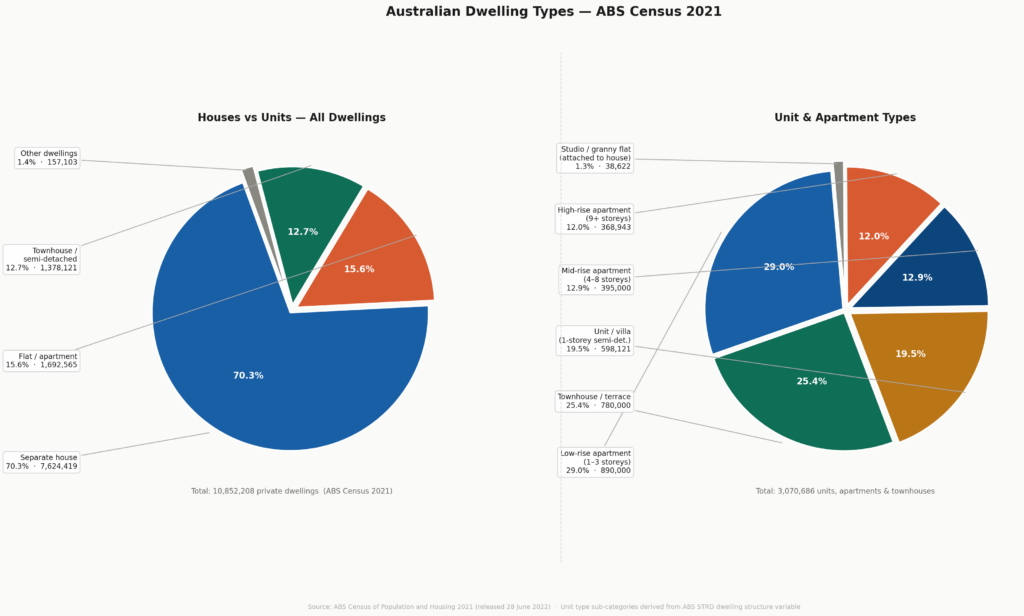
Source: ABS Census of Population and Housing 2021.
Of the roughly 3.07 million non-house dwellings counted in the 2021 Census, low-rise apartments of one to three storeys make up the largest share at 29%, followed by townhouses and terraces at 25.4%, villas and one-storey semi-detached units at 19.5%, mid-rise apartments (four to eight storeys) at 12.9%, high-rise apartments of nine storeys or more at 12%, and studios or granny flats attached to a house at 1.3%. When CoreLogic’s Pain & Gain report talks about “units,” it’s really talking about this entire spread — from a freestanding villa with its own title and land content through to a high-rise apartment in a 40-storey tower.
Units: A Different Set of Rules
For units, the relationship between hold period and outcome is far less reliable — and in some markets it barely exists at all.
There are pockets where the “quick flip equals loss” pattern does show up clearly. In the Australian Capital Territory, units sold at a loss had been held for just 1.8 years. In Regional Victoria, it was 2.4 years. In Regional NSW, 2.7 years. These look like classic cases of buyers — often purchasers of new or off-the-plan stock — needing or choosing to sell shortly after settlement, often into a softer market than the one they bought into.
But look at Melbourne itself, or the national figures, and the story changes. In Melbourne, units sold at a loss had been held for a median of 8.6 years — almost as long as the 8.9-year median for units sold at a profit. Nationally, the two figures are identical: 8.5 years for both pain and gain. In these markets, simply holding on longer hasn’t reliably rescued a struggling unit purchase the way it has for houses. That points to a different kind of risk — oversupply in a given building or precinct, limited land content, rising strata and building costs, or simply buying the wrong product in the wrong location — that time alone doesn’t fix.
The Investor Takeaway
The data supports a genuinely useful, if less catchy, version of the old barbecue wisdom: for houses in Australia’s major established markets, time has historically been one of the most powerful variables in turning a purchase into a profit — Melbourne’s gap between a 2.3-year loss and a 10.2-year gain is about as clear a signal as property data gets. For units, that same safety net is patchier. In some markets, getting out early is clearly where the losses live; in others, including Melbourne and the national figures, owners who lost money held on for nearly as long as those who didn’t.
The practical implication is that house buyers can lean more heavily on patience as a strategy, while unit buyers need to do more of the work upfront — assessing supply pipeline, building quality, owners’ corporation costs, and land content — because a long hold period isn’t a guaranteed substitute for getting the purchase right in the first place.