


Australia’s Property Market Isn’t Falling—It’s Fragmenting
When property prices fall in Sydney or Melbourne, headlines frequently declare that Australia is experiencing a “national property downturn”.
But is it accurate to describe the entire country’s property market based primarily on what is happening in its two largest cities?
Research produced by Simon Pressley, Head of Research at Propertyology, argues that it is not. Australia does not have one single property market. It has more than 400 individual cities and townships, each influenced by different economic conditions, housing supply, employment trends, infrastructure investment and buyer demand.
While some major markets may be declining or experiencing weak growth, many other locations across Australia are continuing to record rising property values.
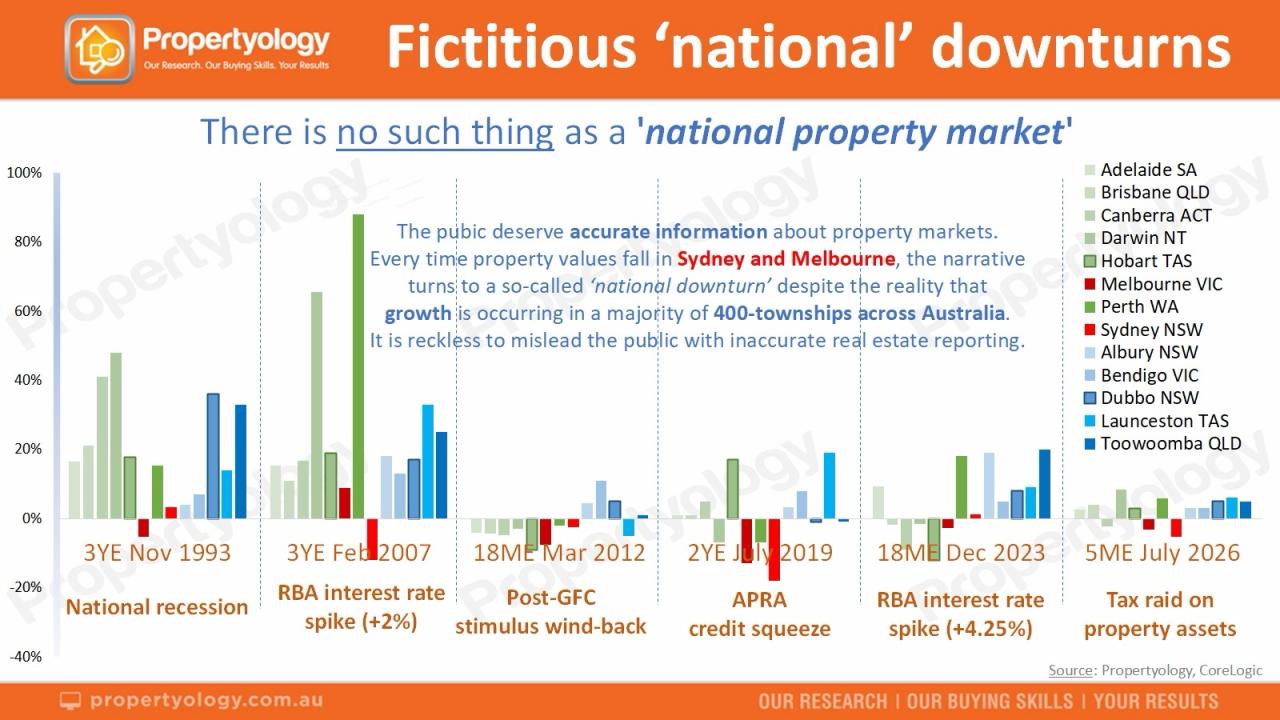
One country, hundreds of property markets
The Propertyology chart above highlights how Australian property markets responded during six challenging economic or policy periods:
- The national recession in the early 1990s
- The RBA interest-rate increases leading into 2007
- The withdrawal of post-GFC stimulus measures
- APRA’s credit restrictions around 2019
- The rapid interest-rate increases leading into 2023
- The property-related tax changes announced in 2026
During these periods, Sydney and Melbourne sometimes experienced falling property values. However, numerous other cities and regional centres continued to grow.
The chart includes examples such as Adelaide, Brisbane, Canberra, Darwin, Hobart, Perth, Albury, Bendigo, Dubbo, Launceston and Toowoomba. Their results varied significantly during each period.
The important message is simple: a downturn in one or two large cities does not automatically mean that every Australian property market is declining.
Growth is still occurring across Australia
According to Propertyology’s research covering Australia’s more than 400 townships, growth continues to occur in a large majority of locations, even while some major cities face difficult conditions.
In its April 2026 national market analysis, Propertyology said capital growth of between 10% and 20% during 2026 was becoming increasingly probable for many Australian townships. It also reported that, apart from two locations, median house values increased across Australian townships during 2025. Thirty-four of Australia’s 50 largest cities reportedly achieved double-digit growth that year. Propertyology: National Property Market Snapshot
Propertyology’s August 2026 analysis acknowledges that buyer activity eased in many locations following the Federal Budget announcements of 12 May. However, it argues that the impact has been more strongly felt through buyer sentiment than through a widespread deterioration in property fundamentals.
The research points to several factors supporting property values in many locations:
- A shortage of properties available for sale
- Strong local employment conditions
- Healthy household equity
- Insufficient new housing construction
- Low rental vacancy rates
- Multiple buyers competing for a limited number of suitable properties
These conditions are not equally strong everywhere. But where several of them exist together, property prices may continue rising despite negative national headlines. Propertyology: Fictitious “National” Real Estate Reporting
Why national averages can mislead investors
A national statistic combines hundreds of different markets into one figure.
This can be useful for understanding the broad direction of Australian housing, but it is much less useful when deciding where to invest.
For example, a national index could be flat because:
- Sydney and Melbourne are declining;
- several other capital cities are growing moderately; and
- selected regional cities are producing strong growth.
The final national number may show little movement, even though individual investors could be experiencing dramatically different results.
National averages can therefore conceal both risk and opportunity.
An investor who assumes that “Australian property is falling” may delay purchasing in a township with strong employment, tight housing supply and rising rents. Conversely, an investor who hears that “Australian property is booming” may purchase in an oversupplied market with weak economic prospects.
Neither decision should be made from a national headline alone.
What property investors should investigate
Property investors should treat national commentary as background information—not as a property-selection strategy.
Before buying, examine the fundamentals of the individual city, township and suburb, including:
1. Local economic strength
Look for diverse and expanding employment sectors rather than relying on one major employer or industry.
2. Properties available for sale
A low and declining volume of listings can increase competition between buyers and create upward pressure on prices.
3. Rental vacancy rates
Tight rental availability may support rent growth and reduce the risk of an investment property remaining vacant.
4. New housing supply
Large development pipelines can restrain price and rental growth, particularly where construction exceeds genuine local demand.
5. Household affordability
Property prices should remain reasonably supported by local household incomes. Strong growth becomes harder to sustain when residents can no longer afford the prevailing prices.
6. Infrastructure and employment projects
Infrastructure is most valuable when it creates permanent employment, improves productivity or attracts new private investment. Announcements alone are not sufficient.
7. Property-specific quality
Even in a strong township, an investor can buy the wrong property. Land content, location, building condition, tenant demand and future resale appeal still matter.
Regional does not automatically mean better
The message is not that every regional township will outperform Sydney or Melbourne.
Regional Australia contains excellent markets, average markets and high-risk markets—just as capital cities do. Some townships may be overly dependent on mining, tourism, agriculture or a single major employer. Others may have stagnant populations, excessive housing construction or limited buyer depth.
The better conclusion is that investors should remain geographically open-minded.
A township should not be rejected simply because it is regional, and a capital city should not be selected simply because it is large and familiar. Each location must earn its place in an investor’s strategy through its underlying evidence.
Property growth has not disappeared—it has moved
The most valuable lesson from Simon Pressley’s Propertyology research is that Australian property cycles are local.
At any given time, some markets will be booming, others will be experiencing steady growth, some will remain flat and a smaller number may decline. These conditions can exist simultaneously.
For investors, this creates both a warning and an opportunity.
The warning is that familiar locations and dramatic headlines can encourage poorly informed decisions. The opportunity is that, across Australia’s universe of more than 400 townships, growth may still be occurring in many locations—even when Sydney or Melbourne is struggling.
Successful property investment is therefore not about predicting whether “the Australian market” will rise or fall.
It is about identifying the right market, selecting the right property and purchasing it at the right price.
Disclaimer: This article provides general information only and does not constitute financial, taxation, legal or property investment advice. Propertyology’s findings and forecasts represent its own research and opinions. Investors should conduct independent due diligence and obtain professional advice appropriate to their circumstances.