


Why some movement, cracking and changes around a concrete slab can be normal — and when you should investigate further
When buying or assessing an established property, one issue that can cause concern is movement around the building or concrete slab. This is particularly relevant in areas where homes are constructed on reactive clay soils.
However, not all movement is necessarily a sign of structural failure.
Reactive clay soils can naturally change volume depending on their moisture content. During wet periods, clay can absorb moisture and expand. During dry periods, it can lose moisture and shrink. This seasonal cycle can cause a building’s slab and surrounding ground to move slightly.
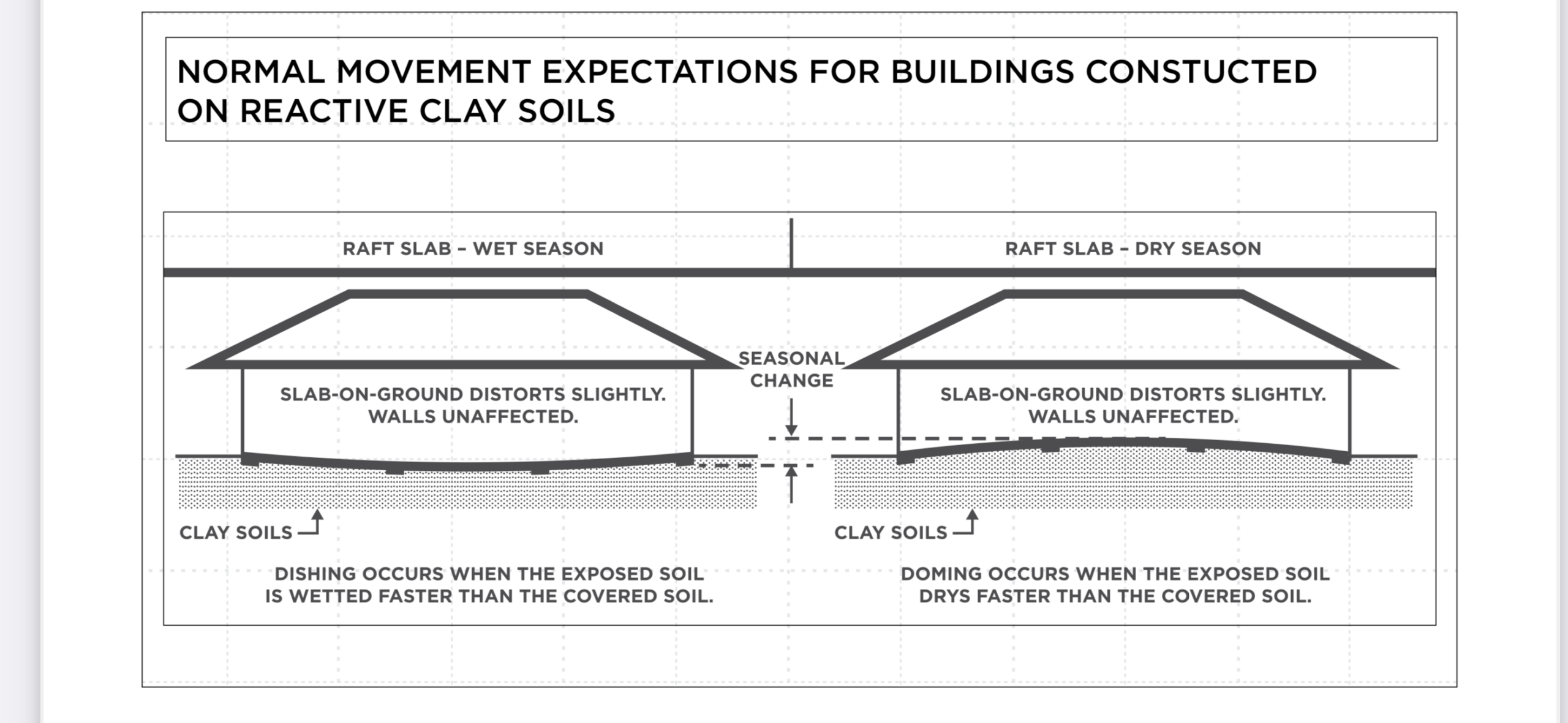
The diagram above illustrates how this movement can occur during different seasons.
What happens during the wet season?
During periods of increased rainfall or moisture, clay soil can absorb water and expand.
The diagram describes a phenomenon known as “dishing”, where the exposed soil becomes wetter than the soil beneath the covered area of the building.
Because the soil outside the building is exposed to rainfall and weather conditions, it can respond differently to moisture changes than the soil underneath the slab.
This difference in moisture content can result in some seasonal movement beneath and around the slab.
Importantly, the diagram indicates that a slab-on-ground may distort slightly while the walls remain unaffected.
This is one reason why minor changes in ground levels or slab profiles should not automatically be interpreted as evidence of serious structural problems.
What happens during the dry season?
The opposite effect can occur during prolonged dry conditions.
As clay soil loses moisture, it can shrink.
The diagram refers to this as “doming”, which can occur when the exposed soil dries more quickly than the soil protected beneath the building.
Again, the different moisture conditions between the exposed and covered soil can produce movement beneath the slab.
The result can be a slight change in the shape or level of the slab as the soil responds to seasonal conditions.
Why does reactive clay matter when buying a property?
Reactive clay soils are important because they can experience greater volume changes than less reactive soils.
For a property buyer, this means that observations such as:
- minor slab movement;
- changes in ground levels;
- small cracks;
- slight variations around paving or concrete;
- seasonal changes in the appearance of cracks; or
- minor movement around external areas need to be assessed in context.
A small crack or slight movement does not automatically mean the property has a major structural problem.
The important question is whether the observed movement falls within reasonable expectations for the building, its age, construction method, soil conditions and surrounding drainage.
Seasonal movement versus structural movement
This distinction is particularly important during a building and pest inspection.
A building inspector will generally consider factors such as the location, size, pattern and direction of cracking, as well as whether doors and windows are sticking, whether floors appear significantly uneven, and whether there are other indicators of structural movement.
Movement that changes with the seasons can be very different from progressive structural movement caused by a foundation problem, inadequate drainage, plumbing leaks, poor site preparation or other defects.
That is why a single observation should not be considered in isolation.
Drainage is particularly important
Water management around a property can influence how reactive clay soils behave.
Concentrated water from leaking gutters, downpipes, stormwater systems or plumbing can create localised changes in soil moisture.
Likewise, vegetation, trees and prolonged dry conditions can affect the moisture content of soil around foundations.
For this reason, prospective buyers should pay attention to:
1. Gutters and downpipes
Check that roof water is being effectively collected and discharged away from the building.
2. Stormwater drainage
Look for evidence of ponding, poor drainage or water collecting next to the slab.
3. Plumbing
Leaks can cause localised soil moisture changes and potentially contribute to movement.
4. Landscaping
Garden beds, irrigation and changes in ground levels close to the building can influence moisture conditions around the foundations.
5. Trees and vegetation
Large vegetation near a building can affect soil moisture, particularly in reactive clay environments.
Should buyers be worried about a property on reactive clay?
Not necessarily.
Reactive clay is a soil characteristic, not a defect by itself.
Many homes are successfully constructed on reactive soils using appropriate engineering, foundation systems and construction practices.
The key issue for a buyer is whether the particular property is showing evidence of movement beyond what would reasonably be expected.
If significant cracking or movement is identified, it may be appropriate to obtain further advice from a suitably qualified building professional, structural engineer or other relevant expert before proceeding with the purchase.
The key takeaway for property buyers
The diagram provides an important reminder: buildings constructed on reactive clay soils can experience some seasonal movement as the moisture content of the surrounding soil changes.
During wet conditions, exposed clay can become wetter and expand, potentially producing a dishing effect.
During dry conditions, exposed clay can dry and shrink, potentially producing a doming effect.
The resulting movement may be relatively minor and, as illustrated in the diagram, a slab-on-ground can distort slightly without necessarily causing significant movement to the walls.
For buyers, the goal should therefore not be to ask simply:
“Is there movement?”
A better question is:
“Is the movement within reasonable expectations, or is there evidence of a potentially significant structural issue?”
That distinction is critical when conducting due diligence on an established property.
Always obtain independent professional advice where significant movement, cracking or other structural concerns are identified.